Rounding and Estimation
Learn More · ID: 5D4539D2
Imagine you're at the grocery store with $20 and need to buy items that cost $3.89, $5.12, and $7.95. Do you have enough money? Instead of calculating the exact total, you can quickly estimate: $4 + $5 + $8 = $17. Yes, you have enough! This is the power of rounding and estimation - tools that help us make quick, reasonable decisions in everyday life.
Rounding helps us work with simpler numbers that are easier to use in mental math. The key is knowing which digit to look at and whether to round up or down.
Rounding and Estimation · 1:23
**Rounding**: The process of replacing a number with another number that is approximately equal and simpler to use, often by making it end in zeros at a specific place value.
The basic rounding rule is simple: if the digit to the right of your rounding place is 5 or greater, round up. If it's 4 or less, round down. Then replace all digits to the right with zeros.
Worked Example
Problem
Round 47,582 to the nearest thousand, hundred, and ten.
Solution
47,582 rounded to different place values
Explanation
Remember to always look at the digit immediately to the right of the place you're rounding to, then replace all digits to the right with zeros.
The same rounding rules apply to decimal numbers. You just need to identify the place value you're rounding to and look at the digit to its right.
Worked Example
Problem
Round 14.65 to the nearest whole number and to the nearest tenth.
Solution
14.65 rounded to different decimal places
Explanation
When rounding decimals, follow the same rule but pay attention to decimal place values instead of whole number place values.
Estimation is about finding approximate answers quickly. It's especially useful for checking if your exact calculations are reasonable. Here are the main strategies:
Worked Example
Problem
Estimate the sum: 3,789 + 5,123 + 2,456
Solution
Approximately 10,000
Explanation
Front-end estimation is the fastest way to get a rough idea of a sum by using only the most significant digits.
Worked Example
Problem
Estimate the sum: 28 + 31 + 29 + 32
Solution
Approximately 120
Explanation
When numbers cluster around a common value, you can use that value times the count of numbers for a quick estimate.
Worked Example
Problem
Estimate the sum: 2,847 + 5,139 + 1,926
Solution
Approximately 10,000
Explanation
Rounding to the nearest thousand makes mental addition much easier while still giving us a reasonable estimate.
Worked Example
Problem
Estimate: 2,156 ÷ 48
Solution
Approximately 50
Explanation
Compatible numbers like 2,000 and 40 make division much easier to do mentally than the original numbers.
Tip
When estimating, it's often helpful to round some numbers up and others down. This helps your overestimates and underestimates balance out for a more accurate result.
One of the most important uses of estimation is checking whether your exact answers make sense. If your calculation gives you an answer that's very different from your estimate, you should double-check your work.
For example, if you're calculating 23 × 47 and get an answer of 108 (too small) or 10,810 (way too big), you can quickly estimate: 20 × 50 = 1,000. Your answer should be close to 1,000, so 108 or 10,810 would indicate you made an error in your multiplication.
Question
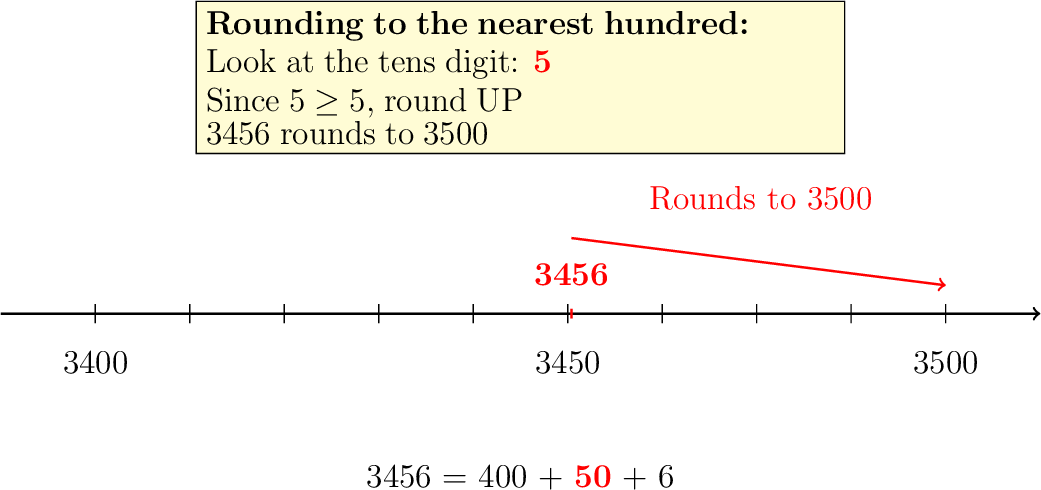
Round 3,456 to the nearest hundred.
Hint
Show Answer
Concept
To round to the nearest hundred, look at the tens digit. If it's 5 or greater, round up. If it's less than 5, round down.
Show Solution
Identify the number: 3,456
Look at the tens digit (the digit to the right of the hundreds place): 5
Since 5 ≥ 5, round up the hundreds digit from 4 to 5
Replace all digits to the right of the hundreds place with zeros: 3,500
Why?
The answer is 3,500 because the tens digit is 5, so we round up to the next hundred.
Question
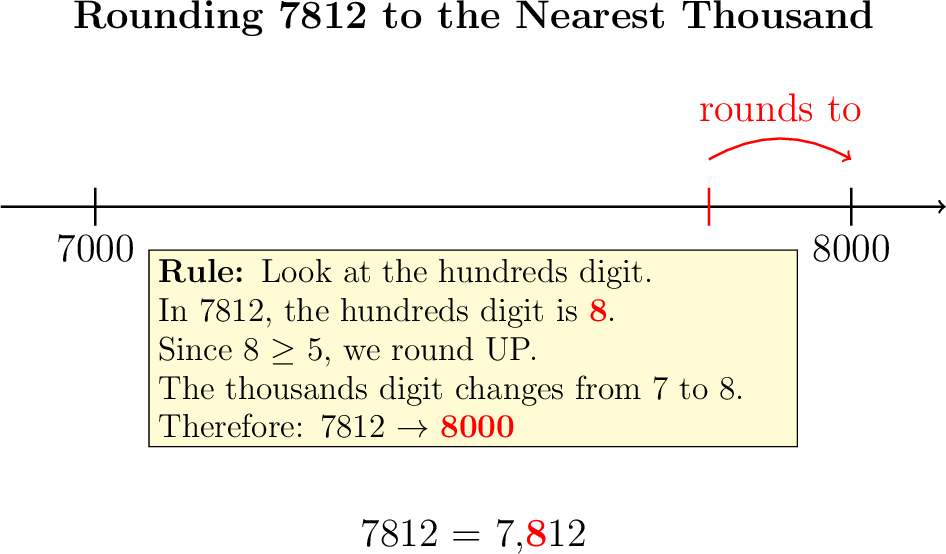
Round 7,812 to the nearest thousand.
Hint
Show Answer
Concept
To round to the nearest thousand, look at the hundreds digit. If it's 5 or greater, round up. If it's less than 5, round down.
Show Solution
Identify the number: 7,812
Look at the hundreds digit (the digit to the right of the thousands place): 8
Since 8 ≥ 5, round up the thousands digit from 7 to 8
Replace all digits to the right of the thousands place with zeros: 8,000
Why?
The answer is 8,000 because the hundreds digit is 8, which is greater than 5, so we round up to the next thousand.
Question
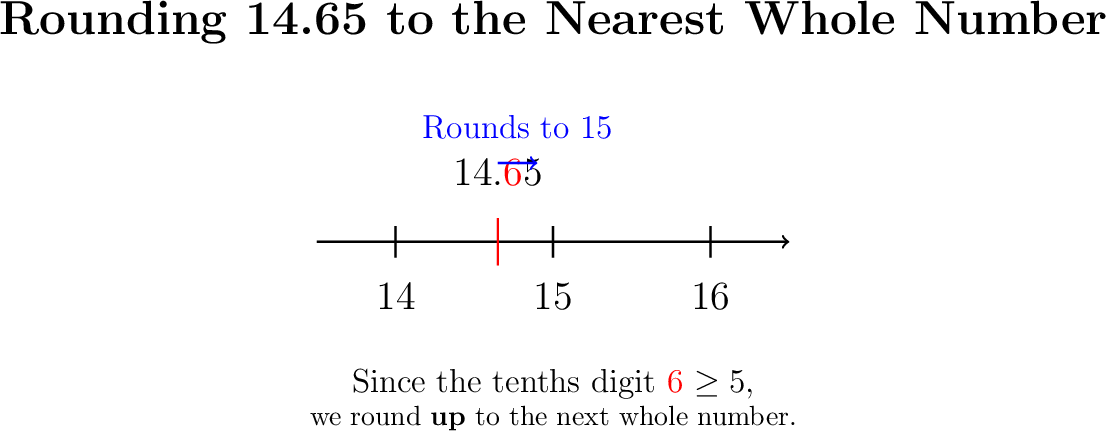
Round 14.65 to the nearest whole number.
Hint
Show Answer
Concept
To round to the nearest whole number, look at the tenths digit. If it's 5 or greater, round up. If it's less than 5, round down.
Show Solution
Identify the number: 14.65
Look at the tenths digit (the first digit after the decimal point): 6
Since 6 ≥ 5, round up the ones digit from 4 to 5
Remove the decimal part: 15
Why?
The answer is 15 because the tenths digit is 6, which is greater than 5, so we round up to the next whole number.
Question
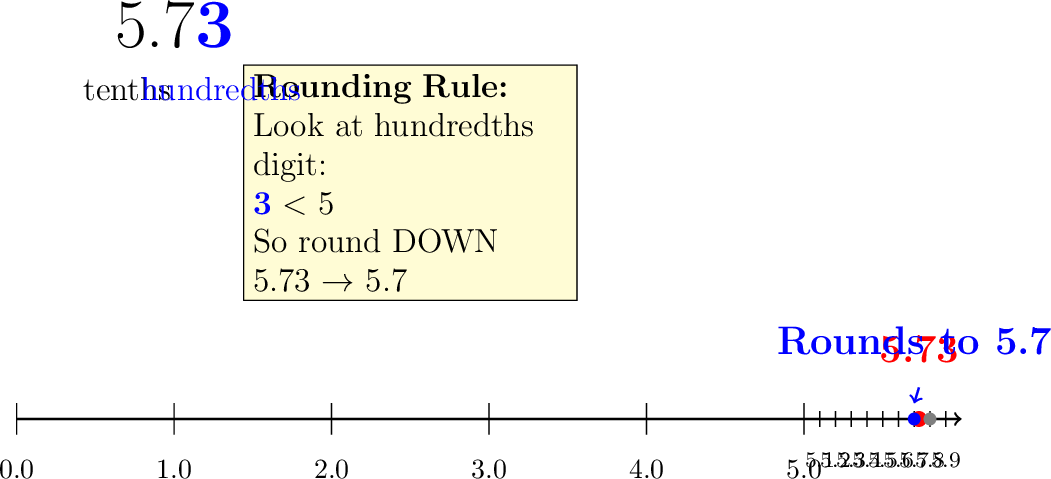
Round 5.73 to the nearest tenth.
Hint
Show Answer
Concept
To round to the nearest tenth, look at the hundredths digit. If it's 5 or greater, round up. If it's less than 5, round down.
Show Solution
Identify the number: 5.73
Look at the hundredths digit (the second digit after the decimal point): 3
Since 3 < 5, keep the tenths digit as 7 (round down)
Remove digits beyond the tenths place: 5.7
Why?
The answer is 5.7 because the hundredths digit is 3, which is less than 5, so we round down and keep the tenths digit as 7.
Question
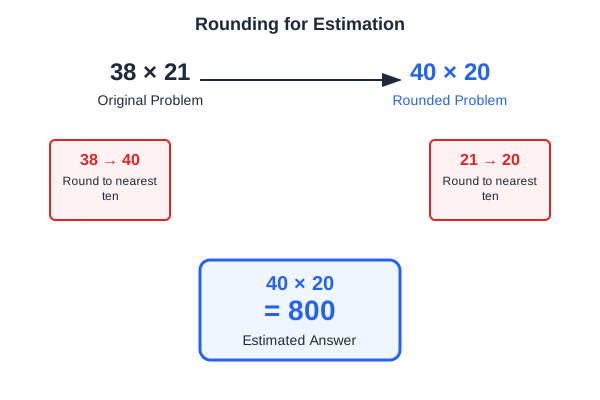
Estimate the product of 38 × 21 using rounding.
Hint
Show Answer
Concept
To estimate a product using rounding, round each factor to a convenient place value, then multiply the rounded numbers.
Show Solution
Round 38 to the nearest ten: 40
Round 21 to the nearest ten: 20
Multiply the rounded numbers: 40 × 20
Calculate: 40 × 20 = 800
Why?
The answer is 800 because 38 rounds to 40 and 21 rounds to 20, and 40 × 20 = 800.
Question
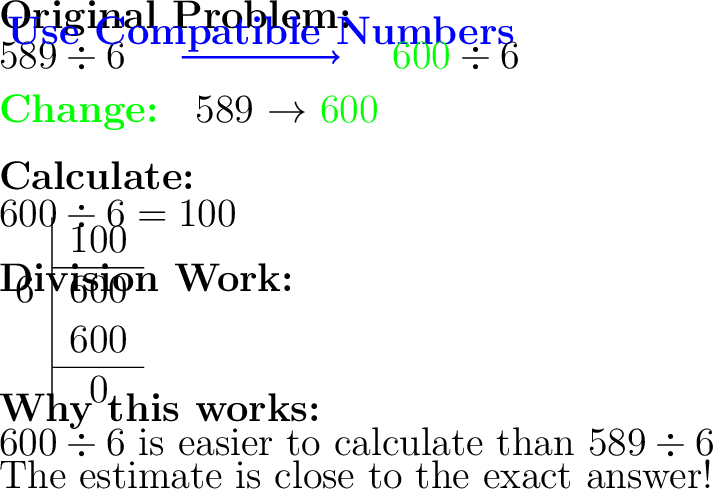
Estimate 589 ÷ 6 using compatible numbers.
Hint
Show Answer
Concept
Compatible numbers are numbers that are easy to divide mentally. Choose numbers close to the original that divide evenly.
Show Solution
Look at 589 ÷ 6 and find compatible numbers
589 is close to 600, and 600 is easily divisible by 6
Use compatible numbers: 600 ÷ 6
Calculate: 600 ÷ 6 = 100
Why?
The answer is 100 because 589 is close to 600, and 600 ÷ 6 = 100.
Question
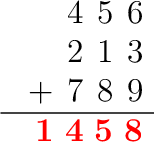
Use front-end estimation for 456 + 213 + 789.
Hint
Show Answer
Concept
Front-end estimation uses only the leading digits (front digits) of each number to make a quick estimate.
Show Solution
Identify the front digits: 456 → 400, 213 → 200, 789 → 700
Add the front-end estimates: 400 + 200 + 700 = 1,300
Look at remaining digits: 56 + 13 + 89 ≈ 150
Adjust the estimate: 1,300 + 100 = 1,400
Why?
The answer is 1,400 because using front-end estimation: 400 + 200 + 700 = 1,300, plus adjusting for the remaining digits gives approximately 1,400.
Question
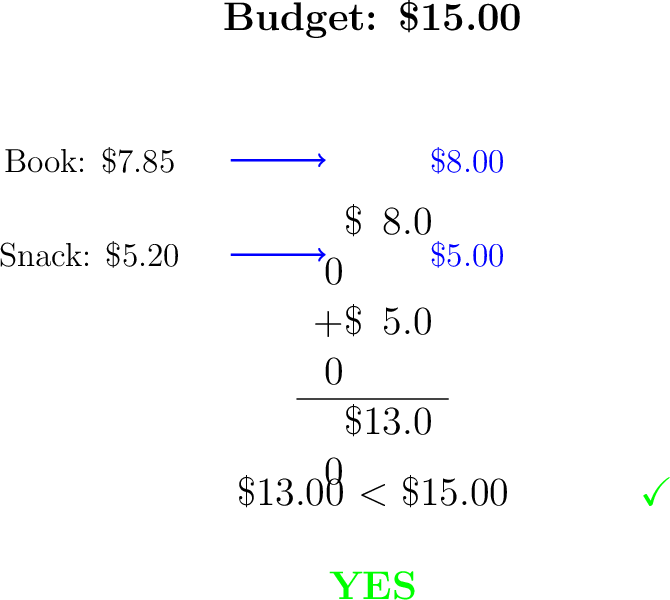
You have $15. Can you buy a book for $7.85 and a snack for $5.20? Use estimation to decide.
Hint
Show Answer
Concept
Use estimation to quickly determine if you have enough money by rounding prices to convenient amounts.
Show Solution
Round the book price: $7.85 ≈ $8.00
Round the snack price: $5.20 ≈ $5.00
Add the estimated costs: $8.00 + $5.00 = $13.00
Compare to available money: $13.00 < $15.00, so YES, you can buy both items
Why?
The answer is Yes because $7.85 rounds to $8 and $5.20 rounds to $5, totaling $13, which is less than $15.