Multi-Digit Multiplication
Learn More · ID: 3FBDBA75
Multi-digit multiplication is like breaking a big job into smaller, easier pieces! Instead of trying to multiply large numbers all at once, we multiply by each digit separately and then add up all our partial products. It's the same multiplication skills you already know, just organized in a smart way.
Tip
Key Rule: When multiplying by the tens digit, add one zero placeholder. When multiplying by the hundreds digit, add two zero placeholders. This keeps your place values correct!
Multi-Digit Multiplication · 1:54
Worked Example
Problem
Find 35 × 12
Solution
420
Explanation
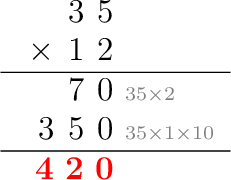
- 1Multiply 35 × 2 (the ones digit). 35 × 2 = 70.
- 2Multiply 35 × 10 (the tens digit). 35 × 1 = 35, but since we're multiplying by the tens place, we add one zero: 350.
- 3Add the partial products. 70 + 350 = 420.
Worked Example
Problem
Calculate 142 × 23
Solution
3,266
Explanation
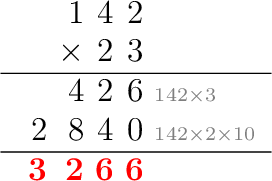
- 1Multiply 142 × 3 (ones digit). 142 × 3 = 426.
- 2Multiply 142 × 20 (tens digit). 142 × 2 = 284, then add one zero for the tens place: 2,840.
- 3Add the partial products. 426 + 2,840 = 3,266.
Question
24 × 13
Show Answer
Show Solution
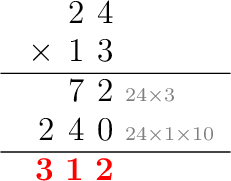
- 1Multiply 24 × 3 (ones digit). 4 × 3 = 12, write 2 and carry 1. 2 × 3 = 6, plus carried 1 = 7. So 24 × 3 = 72.
- 2Multiply 24 × 10 (tens digit). 24 × 1 = 24, add one zero for tens place: 240.
- 3Add partial products. 72 + 240 = 312.
Question
32 × 15
Show Answer
Show Solution
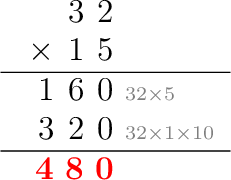
- 1Multiply 32 × 5 (ones digit). 2 × 5 = 10, write 0 and carry 1. 3 × 5 = 15, plus carried 1 = 16. So 32 × 5 = 160.
- 2Multiply 32 × 10 (tens digit). 32 × 1 = 32, add one zero for tens place: 320.
- 3Add partial products. 160 + 320 = 480.
Question
58 × 24
Show Answer
Show Solution
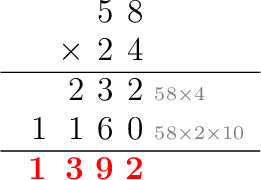
- 1Multiply 58 × 4 (ones digit). 8 × 4 = 32, write 2 and carry 3. 5 × 4 = 20, plus carried 3 = 23. So 58 × 4 = 232.
- 2Multiply 58 × 20 (tens digit). 58 × 2 = 116, add one zero for tens place: 1,160.
- 3Add partial products. 232 + 1,160 = 1,392.
Question
67 × 89
Show Answer
Show Solution
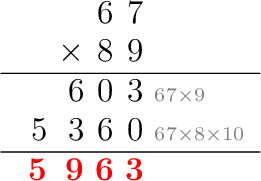
- 1Multiply 67 × 9 (ones digit). 7 × 9 = 63, write 3 and carry 6. 6 × 9 = 54, plus carried 6 = 60. So 67 × 9 = 603.
- 2Multiply 67 × 80 (tens digit). 67 × 8 = 536, add one zero for tens place: 5,360.
- 3Add partial products. 603 + 5,360 = 5,963.
Question
156 × 47
Show Answer
Show Solution
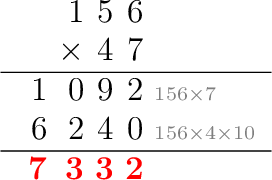
- 1Multiply 156 × 7 (ones digit). 6 × 7 = 42, write 2 carry 4. 5 × 7 = 35, plus 4 = 39, write 9 carry 3. 1 × 7 = 7, plus 3 = 10. So 156 × 7 = 1,092.
- 2Multiply 156 × 40 (tens digit). 156 × 4 = 624, add one zero: 6,240.
- 3Add partial products. 1,092 + 6,240 = 7,332.
Question
284 × 135
Show Answer
Show Solution
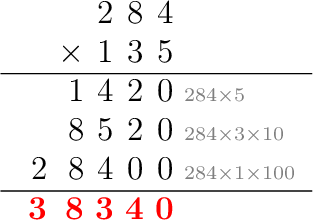
- 1Multiply 284 × 5 = 1,420.
- 2Multiply 284 × 30. 284 × 3 = 852, add one zero: 8,520.
- 3Multiply 284 × 100. 284 × 1 = 284, add two zeros: 28,400.
- 4Add all partial products. 1,420 + 8,520 + 28,400 = 38,340.
Question
307 × 246
Show Answer
Show Solution
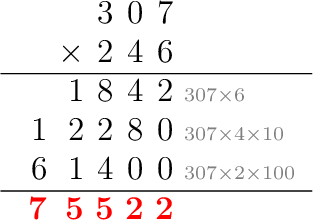
- 1Multiply 307 × 6 = 1,842.
- 2Multiply 307 × 40. 307 × 4 = 1,228, add one zero: 12,280.
- 3Multiply 307 × 200. 307 × 2 = 614, add two zeros: 61,400.
- 4Add all partial products. 1,842 + 12,280 + 61,400 = 75,522.
Tip
Remember: Multi-digit multiplication is just single-digit multiplication done multiple times! Break it into parts, use placeholder zeros to keep your place values straight, and always add up your partial products carefully.