Comparing and Ordering Numbers
Learn More · ID: 6C47F732
When working with large numbers, we need to compare them to see which is greater, less than, or equal to another. Place value is our key tool for making these comparisons. Just like we learned to read and write large numbers using place value, we can use the same understanding to put numbers in order from smallest to largest or compare any two numbers.
Tip
Quick reminder: In place value, each position represents a different power of 10. From right to left: ones, tens, hundreds, thousands, ten-thousands, hundred-thousands, and so on. The leftmost digit has the highest value!
Comparing and Ordering Numbers · 1:26
**Comparing Numbers**: The process of determining which of two or more numbers is greater, less than, or equal to the others using place value and inequality symbols (<, >, =).
To compare numbers effectively, we start by looking at the leftmost digits (the highest place values) and work our way right until we find a difference. This is similar to how we alphabetize words by comparing letters from left to right.
Tip
Important rule: A number with more digits is always greater than a number with fewer digits (when both are positive whole numbers). For example, 1,000 > 999, even though 9 > 1!
Worked Example
Problem
Compare 34,567 and 34,592. Which number is greater?
Solution
34,592 > 34,567
Explanation
When comparing numbers, we only need to compare until we find the first place where the digits are different. Since 6 < 9 in the tens place, 34,567 is less than 34,592.
Tip
Remember: When comparing numbers with the same number of digits, start from the left and compare digit by digit. As soon as you find a difference, you can determine which number is greater without looking at the remaining digits!
Worked Example
Problem
Put these numbers in order from least to greatest: 125,400; 98,750; 125,040; 200,300
Solution
98,750 < 125,040 < 125,400 < 200,300
Explanation
When ordering multiple numbers, it helps to first separate them by the number of digits, then compare within each group using place value from left to right.
We can also use number lines to visualize comparisons. Numbers to the right on a number line are always greater than numbers to the left.
**Inequality Symbols**: Mathematical symbols used to show the relationship between numbers: < means 'less than', > means 'greater than', = means 'equal to', and ≠ means 'not equal to'.
Tip
Memory trick for inequality symbols: The symbol always 'points' to the smaller number, like an arrow. Think of it as a hungry alligator that wants to eat the bigger number!
Worked Example
Problem
Write three different comparison statements using 456,789 and 456,798.
Solution
456,789 < 456,798; 456,798 > 456,789; 456,789 ≠ 456,798
Explanation
Always compare systematically from left to right. Here, 456,798 is greater because it has 9 in the tens place while 456,789 has only 8 in the tens place.
Question
Compare 8,543 and 8,534. Write your answer using < or >.
Hint
Show Answer
Concept
When comparing numbers, start from the leftmost digit and compare place by place until you find a difference.
Show Solution
Line up the numbers by place value: 8,543 and 8,534
Compare the thousands place: 8 = 8, so move to the next place
Compare the hundreds place: 5 = 5, so move to the next place
Compare the tens place: 4 > 3, so 8,543 > 8,534

Why?
8,543 > 8,534 because in the tens place, 4 > 3.
Question
Compare 99,999 and 100,000. Which number is greater?
Hint
Show Answer
Concept
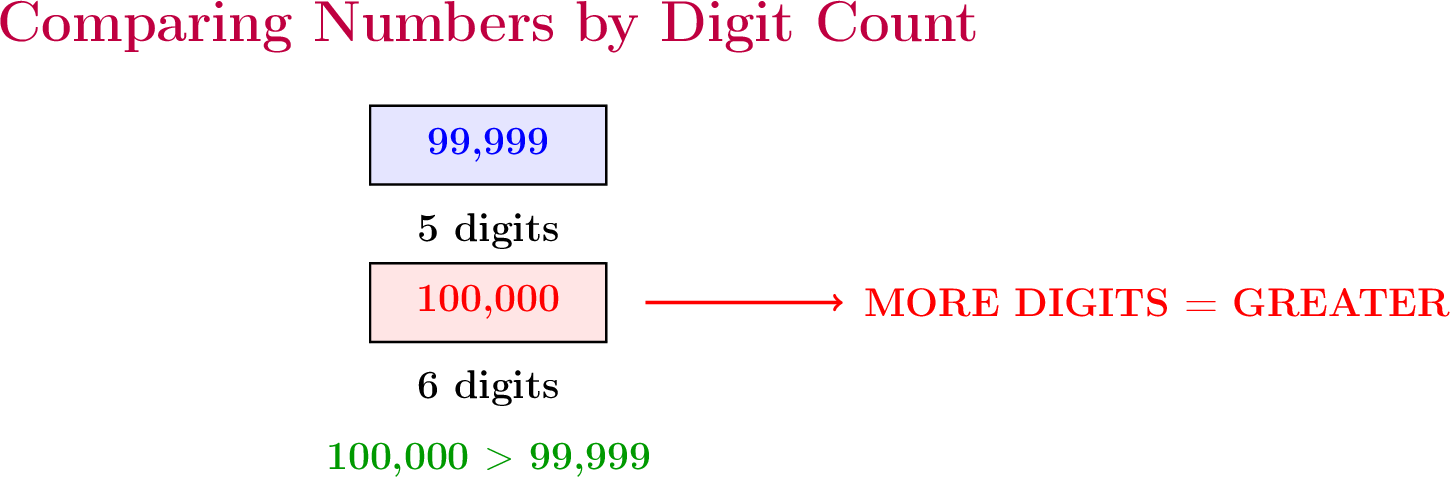
When comparing numbers with different amounts of digits, the number with more digits is always greater.
Show Solution
Count the digits in each number: 99,999 has 5 digits, 100,000 has 6 digits
The number with more digits is always greater
Therefore, 100,000 > 99,999
Why?
100,000 > 99,999 because 100,000 has 6 digits while 99,999 has only 5 digits.
Question
Put these numbers in order from least to greatest: 67,890; 67,098; 67,980
Hint
Show Answer
Concept
To order numbers, compare them two at a time, starting with the leftmost digits and working right until you find differences.
Show Solution
Line up all three numbers by place value: 67,890; 67,098; 67,980
Compare ten-thousands and thousands places: all have 6 and 7, so move to hundreds place
Compare hundreds place: 67,098 has 0, 67,890 has 8, 67,980 has 9
Order by hundreds place: 0 < 8 < 9, so 67,098 < 67,890 < 67,980

Why?
67,098 < 67,890 < 67,980 because when comparing the hundreds place: 0 < 8 < 9.
Question
Write a comparison statement using the = symbol: Compare 45,600 and 45,600.
Hint
Show Answer
Concept
When two numbers have exactly the same digits in the same positions, they are equal and we use the = symbol.
Show Solution
Compare the two numbers digit by digit: 45,600 and 45,600
Ten-thousands: 4 = 4, Thousands: 5 = 5, Hundreds: 6 = 6, Tens: 0 = 0, Ones: 0 = 0
Since all digits are identical, 45,600 = 45,600

Why?
45,600 = 45,600 because both numbers are identical in every place value.
Question
Order these four numbers from greatest to least: 234,567; 23,456; 2,345,678; 234,576
Hint
Show Answer
Concept
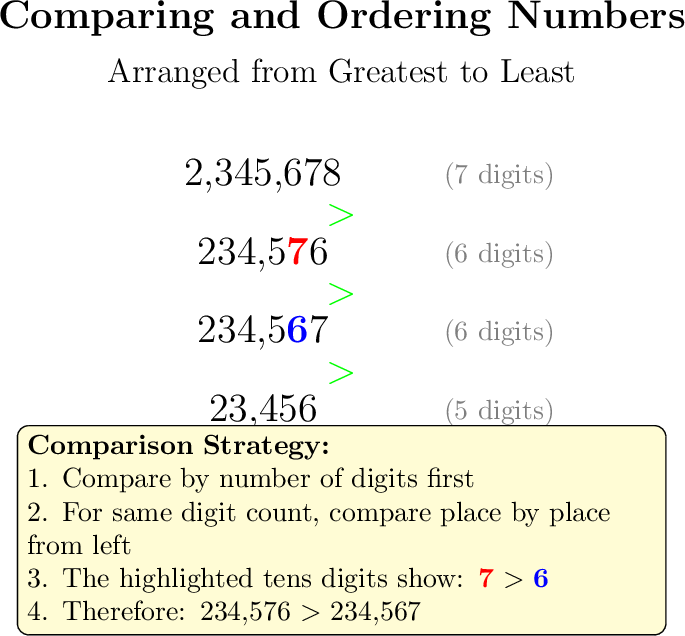
To order numbers from greatest to least, first identify which has the most digits, then compare place by place for numbers with the same digit count.
Show Solution
Count digits in each number: 2,345,678 (7 digits), 234,567 (6 digits), 23,456 (5 digits), 234,576 (6 digits)
The 7-digit number 2,345,678 is greatest
Compare the two 6-digit numbers: 234,576 vs 234,567. In the tens place, 7 > 6, so 234,576 > 234,567
The 5-digit number 23,456 is smallest
Final order: 2,345,678 > 234,576 > 234,567 > 23,456
Why?
2,345,678 > 234,576 > 234,567 > 23,456 because we order by digit count first, then by place value comparison.